
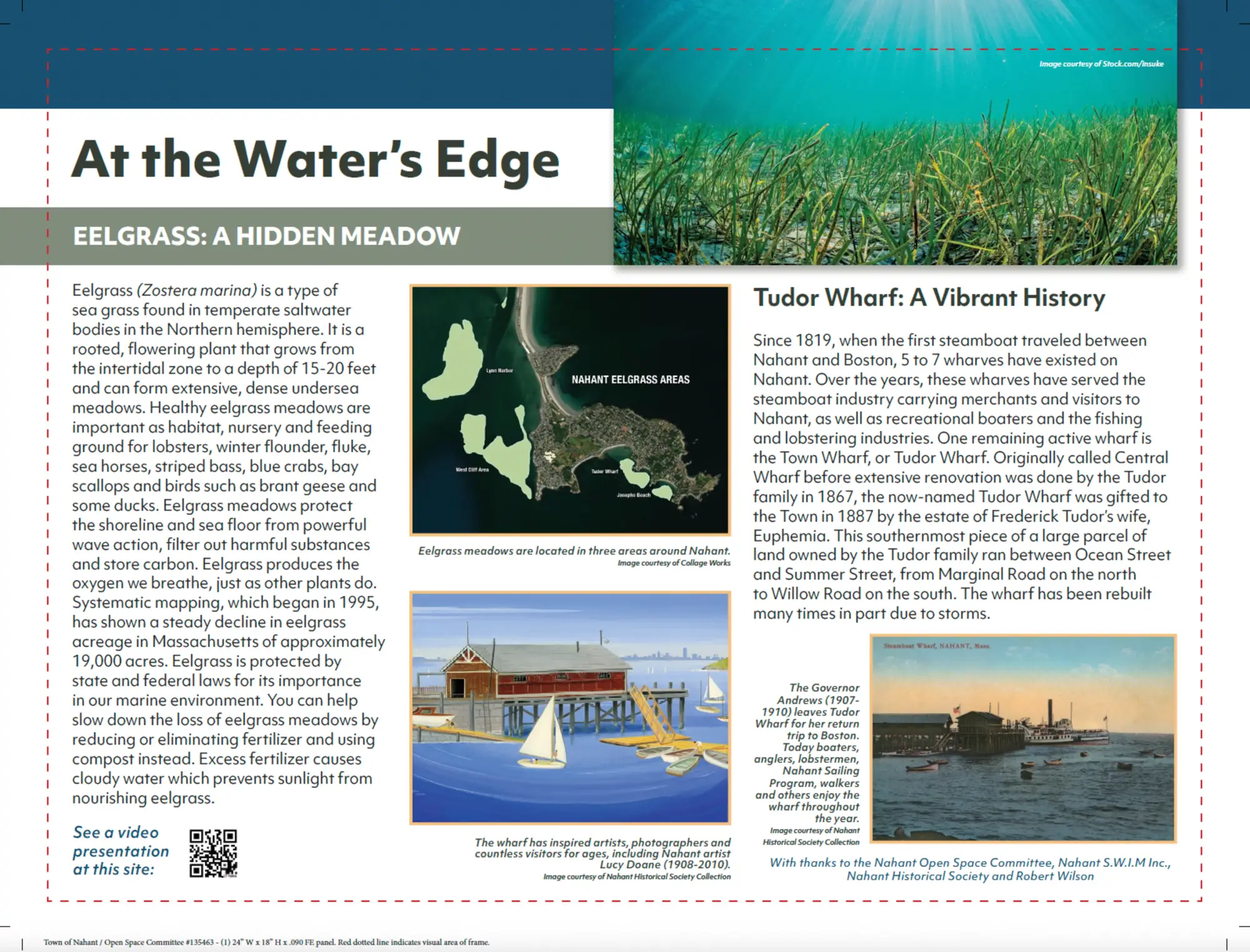
Eelgrass (Zostera marina) is a type of sea grass found in temperate saltwater bodies in the Northern Hemisphere. It is a rooted, flowering plant that grows from the intertidal zone to a depth of 15–20 feet and can form extensive, dense undersea meadows. Healthy eelgrass meadows are important as habitat, nursery, and feeding ground for lobsters, winter flounder, fluke, sea horses, striped bass, blue crabs, bay scallops, and birds such as brant geese and some ducks. Eelgrass meadows protect the shoreline and sea floor from powerful wave action, filter out harmful substances, and store carbon. Eelgrass produces the oxygen we breathe, just as other plants do.
Systematic mapping, which began in 1995, has shown a steady decline in eelgrass acreage in Massachusetts of approximately 19,000 acres Eelgrass is protected by state and federal laws for its importance in our marine environment. You can help slow down the loss of eelgrass meadows by reducing or eliminating fertilizer and using compost instead. Excess fertilizer causes cloudy water, which prevents sunlight from nourishing the eelgrass.
Tudor Wharf: A Vibrant History
Since 1819, when the first steamboat traveled between Nahant and Boston, five to seven wharves have existed on Nahant. Over the years, these wharves have served the steamboat industry, carrying merchants and visitors to Nahant, as well as recreational boaters and the fishing and lobstering industries. One remaining active wharf is the Town Wharf, or Tudor Wharf.
Originally called Central Wharf before extensive renovation by the Tudor family in 1867, the now-named Tudor Wharf was gifted to the Town in 1887 by the estate of Frederick Tudor's wife, Euphemia. This southernmost piece of a large parcel of land owned by the Tudor family ran between Ocean Street and Summer Street, from Marginal Road on the north to Willow Road on the south. The wharf has been rebuilt many times, in part due to storms.